Dr. Kevin Luczynski, PhD, BCBA-D
Bios, headshots, sample talks with abstracts, and a few slides, for interviews, articles, programs, and posts. Download anything below. Please credit Sleepy Star art to Gary Wilkinson.
Links
- universalbcs.comPractice website
- atomicparenting.comAtomic Parenting, a newsletter for parents
- Sleepy Star book flapsHow the book's flaps work at bedtime
- LinkedInlinkedin.com/in/drkevinluczynski
- Universal Pediatric Sleep ProgramHow the sleep work runs with a family
- Universal Starting Point and Universal Life SkillsTraining and consultation for schools and providers
- Curriculum VitaeFull publication and speaking record
- Contact formInterview and speaking requests
Short Bio
About 100 words. For bylines, captions, and event listings.
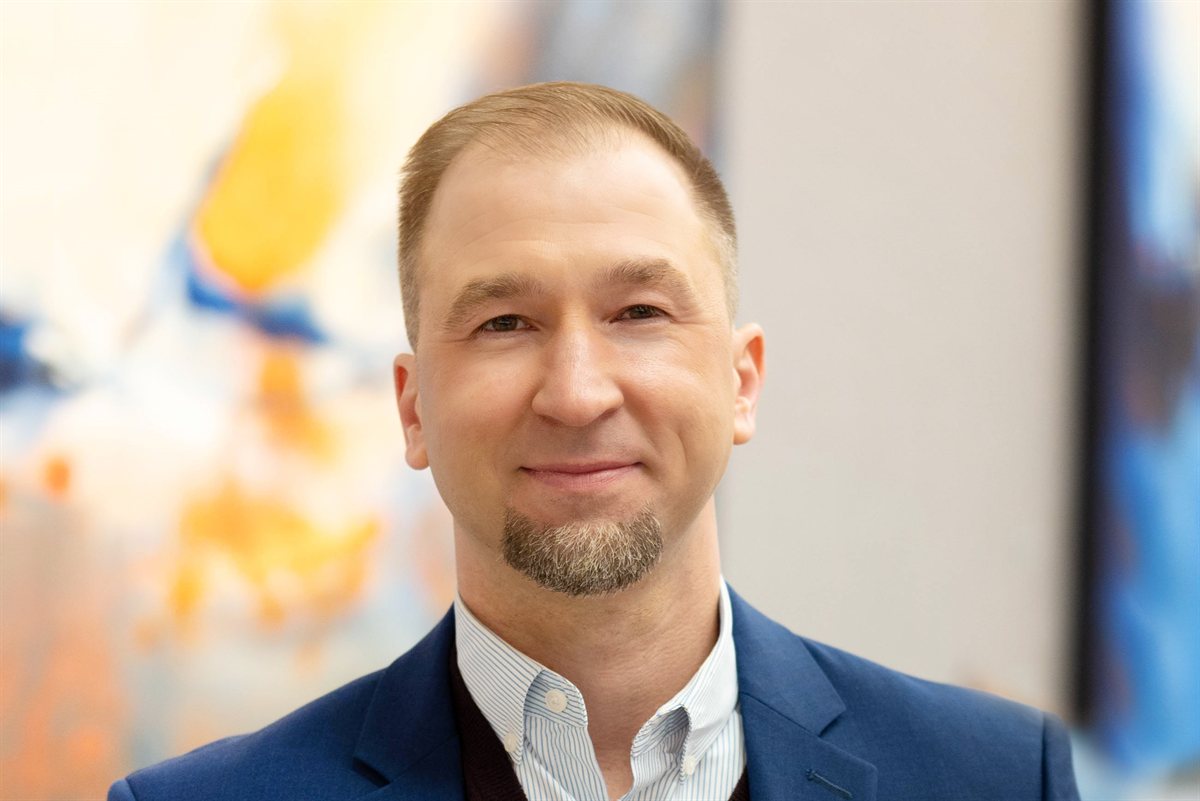
Dr. Kevin Luczynski, PhD, BCBA-D, helps families, schools, and behavioral health organizations prevent behavior and sleep problems and treat the ones already happening. He founded Universal Behavioral Consulting Services in 2023, after more than a decade at the University of Nebraska Medical Center's Munroe-Meyer Institute, where he built a telehealth program and a prosocial interactions program.
He earned his PhD under Dr. Gregory Hanley at Western New England University and has published more than 30 peer-reviewed articles, most in the Journal of Applied Behavior Analysis. With Dr. Derek Reed, he is writing Sleepy Star: A Children's Book as a Bedtime Aid for Parents.
Medium Bio
About 334 words. For program books, podcast pages, and speaker introductions. Third person, the convention for a professional bio.
Dr. Kevin Luczynski, PhD, BCBA-D, is a Board Certified Behavior Analyst and scientist-practitioner who helps families, schools, and behavioral health organizations prevent challenging behavior and sleep problems and treat the ones already happening. He treated learners with severe problem behavior at the Kennedy Krieger Institute and concurrently earned his master's degree at the University of Maryland, Baltimore County. He earned his doctoral degree under the mentorship of Dr. Gregory Hanley at Western New England University. Over the following decade, he developed a telehealth program and a prosocial interactions program at the University of Nebraska Medical Center's Munroe-Meyer Institute, where he mentored 11 doctoral students. In 2023, he founded Universal Behavioral Consulting Services in Omaha, Nebraska, and works with families virtually or in the home.
He has over 30 publications, nearly all in the Journal of Applied Behavior Analysis, and was peer-elected to three consecutive 3-year terms on its Editorial Board. His research addresses universal behavioral readiness, the skills that prepare a child for the disappointing moments when the answer is no, the turn belongs to someone else, or control has to be shared (Luczynski & Hanley, 2013; Rahaman & Luczynski, 2024). From that research, he developed the Universal Starting Point program, which prepares caregivers and clinicians to teach these skills one on one, and Universal Life Skills, which teaches them to small groups of students in the classroom. He also studies the in-home assessment and treatment of pediatric behavioral sleep problems (Lesser et al., 2019) and co-authored an upcoming pediatric sleep chapter in the APA Handbook of Behavior Analysis with Dr. Nicole Rodriguez. His sleep focus is the bedtime routine, one that promotes sleep-compatible behavior and prioritizes parent-child connection. With Dr. Derek Reed, he is co-author of Sleepy Star: A Children's Book as a Bedtime Aid for Parents, due in early 2027.
Dr. Luczynski lives in Omaha with his wife, Dr. Nicole Rodriguez, and their two sons, who supply many of the bedtime stories in his talks, and coaches youth soccer, baseball, and basketball.
The .txt and .docx files hold this bio and the spoken introduction below. The .docx keeps the journal and book titles in italics.
Spoken Introduction
About 70 words, for a host to read aloud before a talk or episode.
Dr. Kevin Luczynski is a Board Certified Behavior Analyst in Omaha who helps families, schools, and clinical teams prevent challenging behavior and sleep problems. He spent more than a decade on the faculty of the University of Nebraska Medical Center before founding Universal Behavioral Consulting Services in 2023, and with Dr. Derek Reed, he is co-author of the forthcoming Sleepy Star: A Children's Book as a Bedtime Aid for Parents.
Headshots and Images
Full-size files. Free to use in articles and posts about this work.





Sample Talks
A few recent talks, to show the topics and the style. The full speaking record is on the CV.
Sleep
- From Evening To Bedroom: A Contemporary Behavioral Account Of The Bedtime Routine With Ethical ConsiderationsMinnesota Northland Association for Behavior Analysis (MNABA) annual conference, 2026
The bedtime routine moves a child from an evening rich in attention, play, and choice to a bedroom with almost none of them, and the stalling and protest that follow are learned behavior. Participants learn where parent-child connection fits inside the routine, how the family chooses the routine's goals and steps, and how to spread preferred activities across the steps.
Abstract
A father says "time to brush your teeth," and his four-year-old sprints back to the Lego tower because those words mean the fun is over until tomorrow. Sleep problems occur in 20% to 30% of young children (Mindell et al., 2006) and in 53% to 78% of autistic children (Krakowiak et al., 2008; Couturier et al., 2005). Across the whole spectrum of learners we serve, sleep rarely gets the attention it deserves given how it can influence learning, attention, and daytime behavior (Mindell et al., 2006). We have to do better. This session asks behavior analysts to reimagine the bedtime routine as the only scheduled hour in the day when nothing competes for the child's attention or the parent's, an hour for connection as well as preparing for sleep. The routine is a transition from an evening rich in attention, play, and choice to a bedroom with almost none of them, and the protests that follow are learned behavior; a functional assessment may show that they regain the fun, delay the routine, or both. A consistent routine is associated with earlier bedtimes, shorter sleep-onset latency, and fewer night wakings in 10,085 children (Mindell et al., 2015) and can contribute to parent-child attachment (Mindell & Williamson, 2017). Participants will see how the planned wake time sets the bedtime window, how a return to play or a cuddle between routine steps removes the bedtime cliff, and how a colored light tells the child what is available.
- Promoting Independent Sleep Initiation: Fading Parental Presence And Changing Sleep DependenciesMNABA annual conference, 2026
This talk covers the part of the night after the child is in the bedroom, so the child learns to fall asleep without a parent in the room and keeps the closeness the family values. Participants learn how a light cue signals what is available at bedtime, how to design the steps for fading a parent's presence, and why starting treatment with a later bedtime helps.
Abstract
An exhausted mother is lying on her daughter's bedroom floor with one arm stretched up to the mattress and her hand around the girl's wrist, because the girl wakes the moment the hand moves and the mother cannot leave the room. The hand on the wrist is a sleep dependency, one of the conditions the child needs to fall asleep, and a dependency becomes a problem when it requires an adult or disappears after sleep onset (depending on the family's cultural and personal preferences). This talk covers the part of the night that begins once the child is in the bedroom. We will discuss an approach that keeps the cuddles, moves them earlier into the routine, and then changes the conditions under which sleep begins one step at a time so the child keeps the closeness and learns to fall asleep without a hand on her wrist. The session shows how to measure contact and proximity, how to build cues that can remain available across the night, and how to choose between contact or proximity fading and time-based visiting or time-based exiting, with the night-by-night schedule for each tactic. Two additional tactics will be described. Faded bedtime with response cost (Piazza & Fisher, 1991) is for the child who is alone in bed but not asleep and the bedtime pass (Friman et al., 1999; Moore et al., 2007) permits one excused trip out of the room after goodnight.
Preventing Problem Behavior
- Preventing Severe Emotional Behavior Before It Happens: The Three Universal Shifts Every Family and Practitioner Should KnowBridgify webinar, 2026
Most challenging moments occur when a learner has not yet developed the skills for three universal shifts: cooperating with expectations set by others, accepting less, and adjusting to change. Participants learn to sort real challenging moments into the three shifts and to turn one family's challenge into a clear goal that points to the missing skill.
Abstract
What would your clinic, classroom, or home look like if the hardest moments no longer defined the day?
Severe emotional behavior can feel sudden, but decades of behavioral research reveal a consistent pattern: most challenging moments occur when learners have not yet developed the skills to navigate three universal shifts in daily life. In this introductory webinar, Dr. Kevin Luczynski, "Dr. L," presents the prevention-focused solution he has refined across homes, clinics, and classrooms, an approach grounded in universal behavioral readiness and supported by more than 60 years of functional assessment and treatment research.
Participants will be introduced to the Three Universal Shifts, cooperation, accepting less, and flexibility, and discover how these foundational skills can prevent severe emotional behavior before it happens. Through relatable examples and clear pre- and post-change analysis, attendees will see how simple, intentionally taught behaviors can reshape emotional readiness and transform everyday routines.
- Teach It Before You Need ItPennsylvania Training and Technical Assistance Network (PaTTAN) webinar with Dr. Tara Fahmie, March 2027
Teaching broadly useful skills before problem behavior develops, extending Preschool Life Skills to kindergarten through grade 12. Participants learn four classroom domains in which problem behavior can develop, how to check which recurring situations a plan covers, and how structured practice, embedded teaching, and feedback support the skills students need.
Podcast
- Inside JABA, Episode 23Recorded 2025
What I Offer
One page on what Dr. Luczynski offers families, schools, and behavioral health organizations: the Universal Pediatric Sleep Program, the Universal Starting Point, and Universal Life Skills. Open it as a web page, or download the image for a flyer or post.
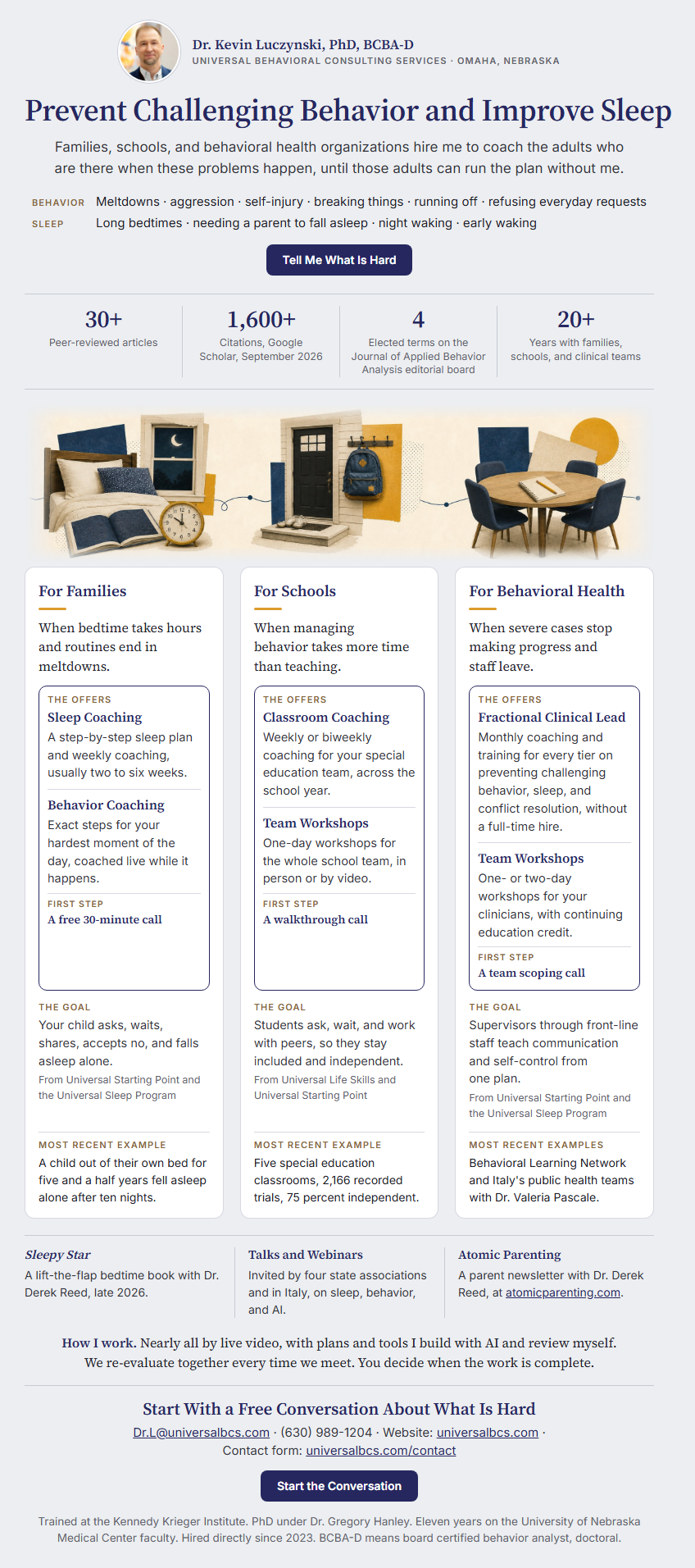
The web page reads best on a phone or laptop. The image is the same content at full resolution for print.